This was my Kol Nidre Sermon for 5787/2026
When our 23-year-old son, Jonah, was preparing to move from Seattle to Washington, D.C. this summer, there was a lot to figure out. Movers. Packing. An apartment. Flights. And I was ready to help.
As I mentioned on Erev Rosh HaShanah, I’m good at problem solving. I see this as part of my job as a dad. A husband. A son. A friend. And as a rabbi. To be a helper, a fixer, a lifter-upper. I know those roles. I love those roles.
So, when Jonah texted me that he needed to find an apartment in the DC area, I went into action. I texted him lots of apartment listings. I was excited about what I was finding. Then I got a text:
“Dad, you’re texting me things I can find on my own. I’ve got this.”
For some parents: a dream text! For me: it stung. It made me sad. My kid doesn’t need me!? I have no role in his young adult life!? Now, this is not what Jonah had texted me. He simply said he could find an apartment himself. But you can hear how quickly I went from “I can do this myself” to “Dad, I don’t need you anymore.”
Here was my son expressing the confidence and independence Cheryl and I want him to have. Taking responsibility for his own life. And somehow, I was struggling with that. I share that struggle on this holiest night of the Jewish year because I suspect I’m not the only person in the sanctuary or online who has held tightly to a role rooted in love—and found it difficult to let that role change. The helper. The fixer. The person everyone turns to. The one who knows exactly what needs to happen next.
Maybe you’ve been on the other side: ready to take a step of your own, but afraid that someone who has supported you will experience your independence as rejection.
How do we allow a relationship to change while honoring everything it has meant to us?
These words are part of the English translation of the Kol Nidre prayer we chanted tonight.
Kol Nidre comes from a world very different from our own. It seeks release from personal vows and self-imposed restrictions—especially those made thoughtlessly, forgotten, or discovered to be impossible to fulfill. It doesn’t erase contracts, debts, legal obligations, or promises made to others. Its focus is personal: the vows we make to ourselves and to God.
Behind its ritual declaration lies a deeply human truth: We can bind ourselves more easily than we realize. To the promises we make to ourselves. To the expectations we take upon ourselves. To the roles we come to believe we must always fill.
No one asked me to vow that I would personally locate every apartment my son might ever live in. But apparently, some part of me had signed up for the job.
Sometimes we bind ourselves for good reasons. What we take upon ourselves may protect us. It may help someone we love. It may give our lives purpose. But on this night of honest examination, we have to ask: What have we taken upon ourselves that once enriched our lives—but may now be unnecessary, limiting to others, or holding us back? That question reaches into our families, our friendships, our work, and our sense of who we are as a people. What connections in your life need your attention tonight?
The bond I have with my children, Jonah and Abigail, is, thank Gd, strong. But Jonah has helped me understand that it’s a bond that needs to evolve. He and Abigail need their independence. And I need to learn how to step back without feeling that I’m somehow less their dad. I’m not sure what that looks like yet, but I’m working on it.
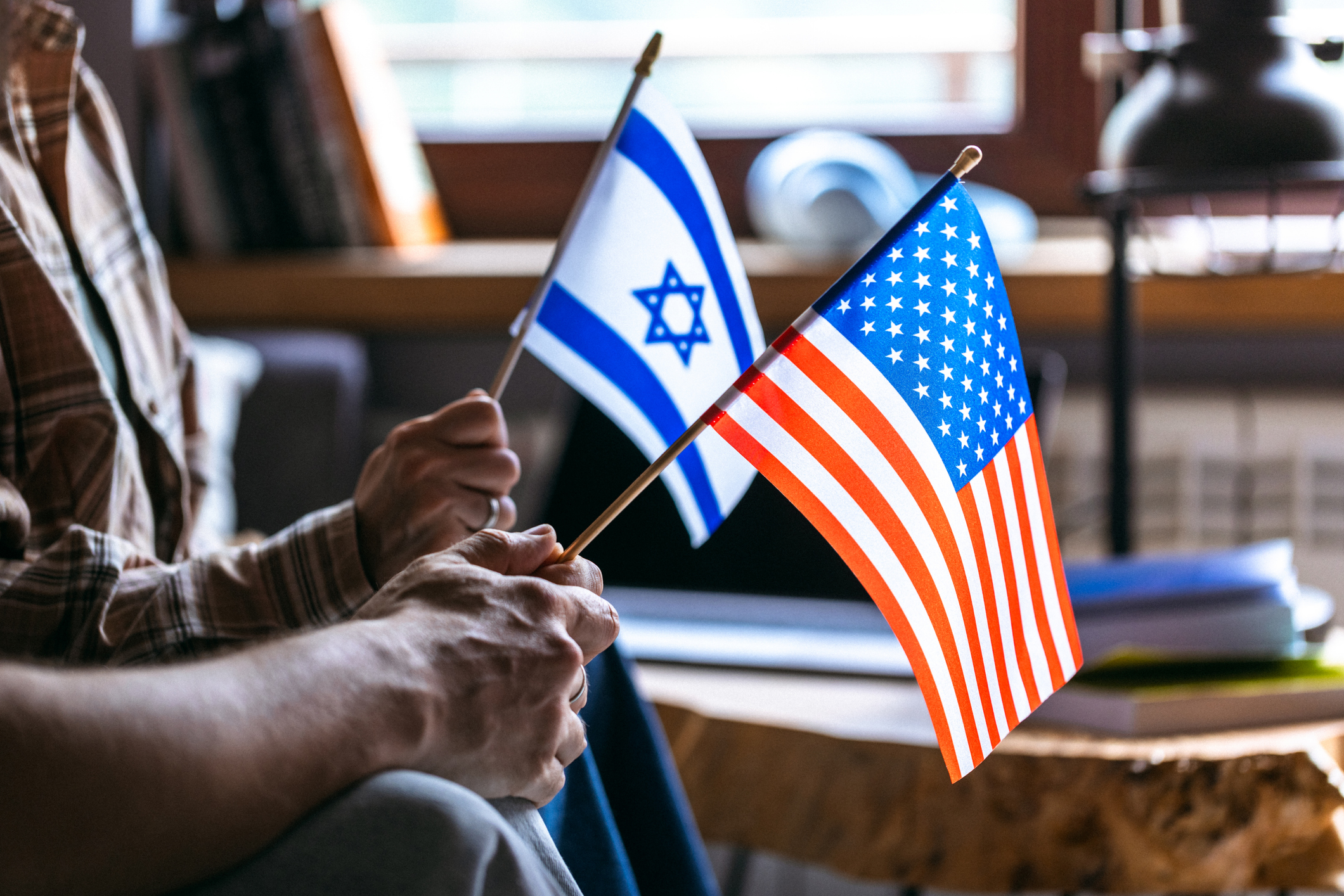
Interestingly enough, this personal struggle is deeply connected to a question I have been thinking a lot about–one pertaining to our larger Jewish community: Can we, as American Jews, be grateful for the powerful relationship between Israel and the United States—a relationship that has helped sustain the Jewish state—and still ask whether its current form should define Israel’s future?
This is a question about freedom, responsibility, and the courage to change. It’s also a question about Zionism: the right of the Jewish people to self-determination, freedom, and independence in our ancestral homeland.
What does that independence require of us in this new year, 5787?
How secure can Jewish sovereignty be while Israel’s ability to defend itself depends so heavily upon the decisions of another nation?
We can’t explore these questions honestly without first acknowledging what American assistance has made possible. It has helped Israel defend her people. It has helped build and sustain missile-defense systems—Iron Dome, David’s Sling, and Arrow—systems that stand between Israeli civilians and incoming fire. It has provided military equipment Israel has needed to protect its people. American assistance has saved Israeli lives.
Israel has every reason to be grateful. Those of us who are American Zionists have every reason to be grateful as well.
And the relationship serves American interests. Israel purchases American equipment, shares intelligence, and works with the United States on defense technology. It is a strategic partnership with benefits for both nations.
That matters when we hear Israel described as nothing more than a burden to the American taxpayer.
And when support for Israel is described as “funding genocide,” I reject that characterization. Palestinian suffering is real. The loss of innocent life must trouble us, and Israel’s policies and military decisions must remain open to moral scrutiny. I also believe Israel has the right and the responsibility to defend its people.
American support has helped Israel meet that responsibility, and we should honor what it has made possible. But gratitude does not place an arrangement beyond honest examination.
Let me come back to my personal life – to Jonah. In response to my apartment texts, he responded: “I’ve got this.” So I let him be. I had to. He was right. I stopped sending him apartments. And darn it, he found a place all by himself. And he’s settled.
The Talmud tells of rabbis who challenge a heavenly voice trying to sway their decision on a question of Jewish law. The Torah, the rabbis insist, has been entrusted to us. We must take responsibility for interpreting it—rather than leave the decision to God. In response, Gd smiles and says, “My children have triumphed over Me.” Apparently, Gd handled “I’ve got this” better than I did. Perhaps Gd’s smile is something I can learn from.
Jonah was showing me the independence Cheryl and I had helped him develop. I should take pride in that—even while adjusting to what it meant for me. I’m still his dad. But being his dad requires me to make room for the adult he has become. I’m learning that being needed differently does not mean being loved any less. Our relationship is strong enough to grow and change. I have to learn to let it, and smile.
Of course, an alliance between two sovereign nations is different from the relationship between a father and son. But there is a question worth asking about both: Can the strength we’ve gained from a relationship become the foundation for that relationship to evolve?
For my kids and me, I’m certain the answer is yes. And I believe Israel and America can also build on the strength of their bond—with greater Israeli independence and a friendship that endures. And so, on this holy night, I want to ask: Has Israel’s reliance on American aid left her security too vulnerable to the changing tides of American politics? I believe it has.
The United States has every right to put its own national interests first. We may agree or disagree with how a particular administration defines those interests. But Israel must be prepared for moments when American priorities and its own security needs do not align. The question, then, is what it would take to reduce that vulnerability while preserving this vital alliance.
The proposal I want us to consider is this: Israel should not turn down American assistance today. It should not walk away from its partnership with the United States. But it should begin preparing for a future in which it can say: We value America’s support. We welcome America’s partnership. And as a strong, prosperous, independent nation, we have built the capacity to take responsibility for our own defense—because we can, and because American policy can change.
By no means am I calling on the United States to cut aid to Israel. I would oppose that vehemently. I am calling for Israel to build the capacity to need less US support—a transition Israel chooses and prepares for, in partnership with America, with its security guiding every step.
“I’ve got this” is easy to say. Making it true takes work.
For a nation, that requires resources, difficult choices, and time.
Israel can’t responsibly walk away tomorrow from weapons already ordered, defense systems already integrated, or resources it currently needs to protect its people.
Any transition must be carefully planned: expanding Israel’s defense industry, increasing its ability to manufacture essential weapons and ammunition, and strengthening joint research and co-development as direct assistance is gradually reduced. The goal is a stronger relationship between two independent allies, each contributing to what they build, share, and defend together. Greater independence must be something Israel prepares for—not simply something it declares.
This idea is neither new nor mine alone. Former Prime Minister Naftali Bennett, who is running again for that position, and current Prime Minister Benjamin Netanyahu have both spoken about moving Israel toward greater independence from American military aid. Analysts at the Foundation for Defense of Democracies, whose Executive Director, Jonathan Schanzer, has spoken on this bimah, have also examined how this relationship might change. These discussions differ in their details, but they make clear that greater Israeli independence from American military aid is a serious possibility worth exploring.
Throughout these High Holy Days, we have spoken about waking up. Standing up. Showing up. Tonight, we come to the final spiritual invitation: Return or, in Hebrew, Teshuvah. Teshuvah asks us to take responsibility for who we are becoming. Sometimes that means rethinking an old expectation. Sometimes it means claiming a responsibility we’ve avoided. Sometimes it means trusting someone we love to do more for themselves.
Whether we are parents, spouses, children, friends, employees, or employers, our spiritual work is learning how our roles must evolve while remaining true to our purpose.
And that work belongs to us as a people, too.
For Israel, I believe that means renewing Zionism’s promise of Jewish responsibility for Jewish survival, security, and the future.
Theodor Herzl expressed that promise in words that still speak to us: “We shall live at last as free [people] on our own soil.” Freedom on our own soil must include the ability to defend that soil and its people.
One of the earliest thinkers of modern Zionism, Leon Pinsker, who lived in the 19th century, argued that Jewish safety could never depend solely upon the goodwill of others. He called his vision “auto-emancipation”—the liberation of the Jewish people by the Jewish people. And that’s part of what Yom Kippur asks of us—to take responsibility for our own transformation, rather than wait for someone else to free us from what holds us back.
Pinsker wrote: “We must first of all desire to help ourselves. Only then will the help of others as well be sure to come.” There is room in Pinsker’s vision for the help of others. And there is an insistence that we take responsibility for our own future.
More than 2,000 years ago, the great Hillel asked: “If I am not for myself, who will be for me? But if I am only for myself, what am I? And if not now, when?” These questions ask something of each of us personally—and of us as a people.
Israel must be for itself. Its survival is not its only responsibility. But it must be its first responsibility. And Israel cannot be only for itself. It must continue building alliances, sharing knowledge, contributing to the security of the wider world. Israel must also explore how it can communicate its story, values, and realities more effectively to the world.
Hillel holds responsibility for ourselves alongside responsibility to others. We need both.
That is my hope for Israel and America: that they remain deeply connected and strong allies, while Israel becomes less vulnerable to changes in American policy.
This shift has the potential to affect us: Jews here in America.
When Israel becomes the subject of American political arguments, as it is right now, the consequences don’t remain in Jerusalem or Washington. They enter our elections, as we well know. And—fair or not—they shape the way our fellow Americans speak about and sometimes act toward us.
Whatever our relationship with Zionism, Israel’s place in American political life has become personal for all of us. This is our reality.
Greater Israeli self-reliance may help weaken the recurring claim that Israel survives at America’s expense—and make American aid to Israel less of a political wedge issue. Wouldn’t that be welcome? Of course, it won’t eliminate antisemitism or end political arguments about Israel. But any easing of those tensions would make a difference.
This being said, hatred directed at the Jewish State must not dictate Israel’s choices—or our reasons for seeking change. The reason for pursuing greater self-reliance must be to strengthen Israel’s freedom to defend its people and determine its own future.
So, on this night of release, I ask us to explore how we can best support a new direction for the US-Israel relationship—one that preserves our partnership while moving Israel, gradually and responsibly, toward greater military independence.
This, I believe, is key to Zionism in 5787. Not the end of friendship, but a reduction in dependence. Not the rejection of partnership, but the confidence to stand beside our partners as a sovereign equal. Not an end to gratitude, but a renewed commitment to Jewish responsibility. That responsibility belongs to us as a people.
And this night asks something of us personally, too. So where might that work begin for you? Perhaps someone needs you to trust them with more responsibility. Or perhaps you are the one who needs to take a step toward more responsibility—to make a decision, to use your own voice, to begin doing something you’ve always relied upon someone else to do.
And as we think about Israel tonight, can you imagine a strong partnership between Israel and America that depends less on American aid? Can you welcome that possibility without feeling that you’re turning away from a relationship you deeply value?
Receiving help is part of being human. We will all need it. The question is whether the ways we give and receive help leave room for all of us to grow.
Jonah’s words were simple: “I’ve got this.” I’m learning to hear the possibility in those words: a relationship that can grow because there is love enough to let it change. And when I think about Israel’s future, I want us to make room for possibility, too.
My hope is that the next generation of Israelis will inherit both an enduring friendship with America and greater freedom to determine their own future. That’s the human hope behind the change I am asking us to consider.
On this night, we return to the bonds we cherish—and ask what they truly need from us now. I believe we can honor everything that has sustained these bonds while finding the courage to imagine what comes next.
If not now, when?



Leave a Reply