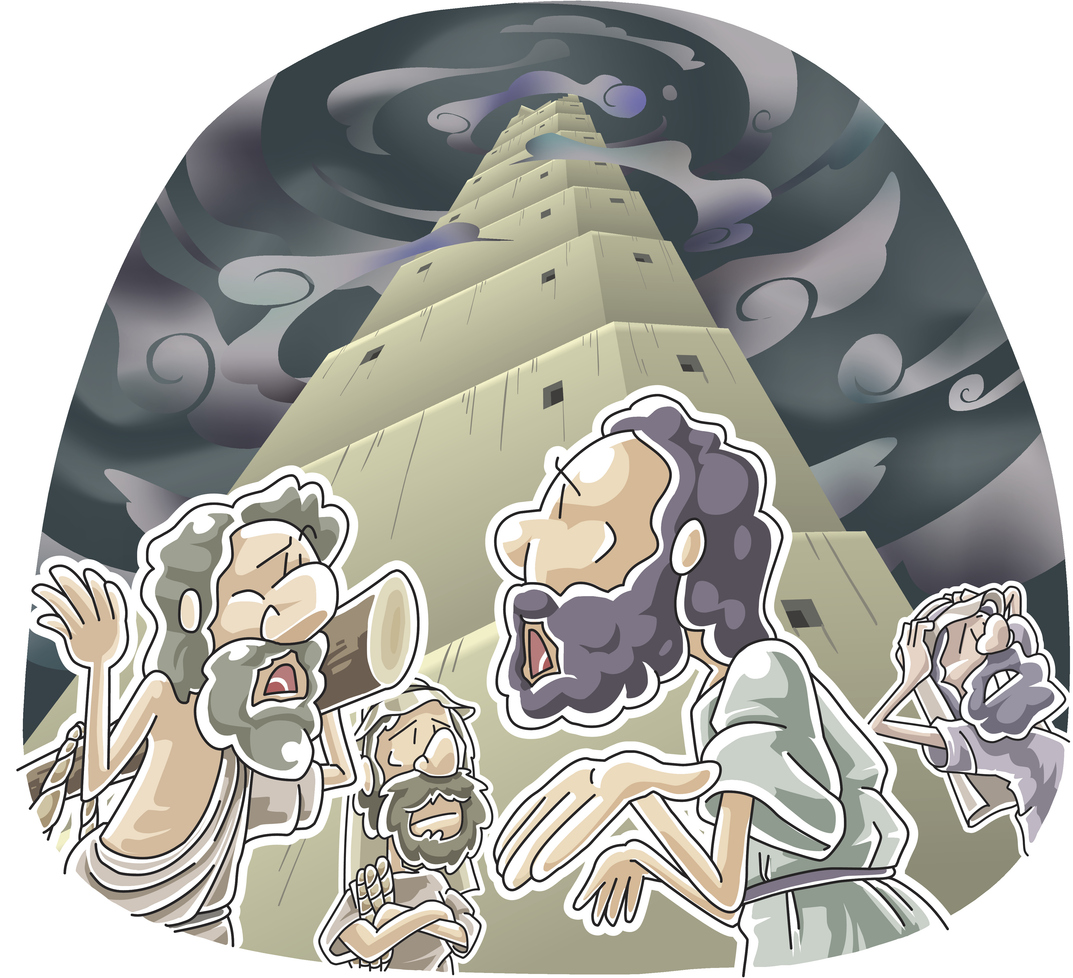

Fairly early in the Book of Genesis, we get a glimpse of what appears to be peace on earth. “The whole earth was of one language and of one common purpose.” (Genesis 11:1) On the earth we live on today, where we not only speak many different languages, but we are also incapable of wrapping our heads around the thoughts, ideas, and goals expressed by family, friends, and neighbors who speak the same language we do, a world where everyone speaks the same language and shares a common purpose sounds like paradise.
In the Torah, this paradise is known as the city of Bavel (often called Babel). The people of Bavel were committed to building together. They said to each other, “let us make bricks,” (Genesis 11:3) the building blocks of what would become “a city and a tower with tops in heaven.” (Genesis 11:4) As the citizens of Bavel spoke the same language and shared common goals, there were not the societal divisions we know all too well these days. Within our own US Jewish community, there is so much disgust for those who don’t share our views on the candidates for President of the United States, or who don’t support our stance on the war in Israel. None of this disgust would have been comprehensible to the citizens of Bavel.
So, why is it that the Torah details how God destroys Bavel, shattering what appears to be the idyllic unity that defined the city? Why does God obliterate the common language shared by the people, creating a myriad of languages and, as the Torah says, “confounded” the people of Bavel, making it impossible for them to understand each other? Additionally, why is it that God scatters the people of Bavel all over the face of the earth abruptly ending the building of what, on the surface, appears to be the ideal city of brotherly/sisterly love? The answer lies in the ninth-century text Pirkei D’Rabbi Eliezer which teaches that what appears to be unity within Bavel was only a group of people concerned with building their city, “the tower with tops in the heaven.” Rabbi Eliezer explains that those in Bavel didn’t really care about each other. He teaches that the tower:
had seven steps from the east and seven steps from the west. Bricks were hauled up from one side, and the descent would be from the other. If one man fell and died, no attention was paid to him, but if one brick fell down, they would sit and weep…
We learn from this that the unity of Bavel was superficial. Digging a little deeper, it was not a place where folks really looked out for each other. A society that is focused on the power of bricks, not humanity, is not united at all. God sees this and puts an end to this superficial unity by creating diversity: a myriad of languages, homelands, and viewpoints.
While some might see God’s action as a punishment, the creation of diversity was a much-needed course correction for humanity. We know that human beings were created to be partners with God, working side by side with God to repair and build this world. Through the experience at Bavel, God learns that conformity will not lead to a better world. It is by working with those who are different from us, finding ways to build consensus, this is how we repair and build this world.
Before God puts an end to Bavel, God models consensus building. God does not decide the plight of the people of Bavel alone. God turns to the diverse group of angels and says, “come let us go down” (Genesis 11:7) and together figure out how to resolve this crisis of conformity. God did not need to do this. God is perfectly capable of putting an end to problems associated with humanity without the input of others. While we might not like the way God handled crises that came before Bavel, we simply need to look at how God dealt with Adam, Eve and the generation of Noah to see how God acted unilaterally. When it comes to Bavel, we see God changing, collaborating with others, getting input from an array of heavenly hosts. Only after this, does God act.
God’s action in this story, action that reflects the input of the angels, shifts the focus from conformity to diversity. As a result, our world is defined by a beautiful mixed multitude of people, languages, cultures, races, religions, ethnicities, and opinions. This is reflected in our global Jewish community, and even in our RSBI community. While diversity is indeed a beautiful thing, we know that it can be challenging. It is why, on the surface, the uniformity that defined Bavel is appealing.
Here in our own congregation, diversity can create divisions when it comes to issues as simple as what melodies we sing at Shabbat services to complex issues like US politics and the war in Israel. These divisions too easily push some of us into the shadows or worse, right out the door. The Talmud teaches us that “all Jews are responsible for one another.” (Shavuot 39a) This does not mean that we need to see eye to eye on all synagogue issues or larger issues surrounding our country, Israel and the world. This is not what God wanted when the decision was made to eliminate the uniformity of Bavel. God wanted diversity and still does. But, through meeting with the angels, God also taught us all how diversity can become harmony.
As members of a diverse community, our job is not to demand what we want. This is expecting our community to embrace conformity. This is selfish and this is what led to the demise of Bavel. Amidst a diversity of opinions, we must put down the bricks we want to use to build what we want and listen to each other, just as God listened to the angels. We must learn that what we want is not always what is best for the group. Compromise is part of calling a diverse community home. Compromise does not mean every opinion will be reflected in the final decision, but, at the very least, every opinion will be heard. If we have the courage to embrace respect and kindness, tolerance and love, and the fact that our views are just one of many views, the diversity that God and the angels gave to us can become harmony.
I continue to be grateful to all of you who engage with me after I send out a weekly message or share a sermon, responding with your thoughts and opinions. Please, keep doing so! And as all of us work to bring harmony to our synagogue community, lets continue to do the holy work of building RSBI and celebrating the diversity that defines us.



Leave a Reply